Employee Attrition Analysis
Employee Attrition Analysis —
Identifying Drivers of Employee Turnover and Targeting High-Risk Employees
This project analyzes employee data to understand the key factors that influence employee attrition and to help organizations proactively identify employees at risk of leaving.
By analyzing employee demographics, job satisfaction, workplace environment, compensation, and tenure, this project uncovers patterns associated with employee turnover and provides actionable recommendations for improving employee retention.
The analysis ultimately identifies 29 employees who show similar characteristics to past employees who left the organization, enabling HR teams to take targeted action before attrition occurs.
Business Problem
Employee turnover is costly for organizations. Recruiting, onboarding, and training new employees require significant time and resources.
HR teams need data-driven insights to answer key questions:
-
What factors influence employee attrition?
-
Which employee groups are most at risk of leaving?
-
What actions can management take to improve retention?
This project uses HR analytics to uncover patterns in employee behavior and provide recommendations for improving employee retention.
Dataset Overview
The dataset includes employee demographic information, job characteristics, and satisfaction metrics.
Key variables include:
-
Age
-
Department
-
Education level
-
Job satisfaction
-
Environment satisfaction
-
Monthly income
-
Performance rating
-
Salary increase percentage
-
Stock option level
These variables allow us to analyze how workplace conditions and compensation influence employee retention.
Data Preparation
The data was cleaned and organized to support analysis.
Steps included:
-
Verifying data completeness (no missing values)
-
Creating grouped variables such as age ranges
-
Creating categorized satisfaction levels
-
Organizing features to improve visualization and interpretation
These transformations helped highlight patterns in employee attrition across demographic and job-related variables.
Attrition Overview
The dataset shows that approximately 16% of employees left the company, while 84% remained.
This indicates that although most employees stay, there is still a meaningful portion of the workforce leaving, which can create operational and financial challenges for the organization.
Employee Demographics
We analyzed the distribution of employees across several key demographic categories.
The analysis shows patterns in:
-
department distribution
-
education levels
-
age groups
-
gender distribution
Understanding these characteristics helps contextualize attrition patterns across different employee segments.
Job Satisfaction Analysis
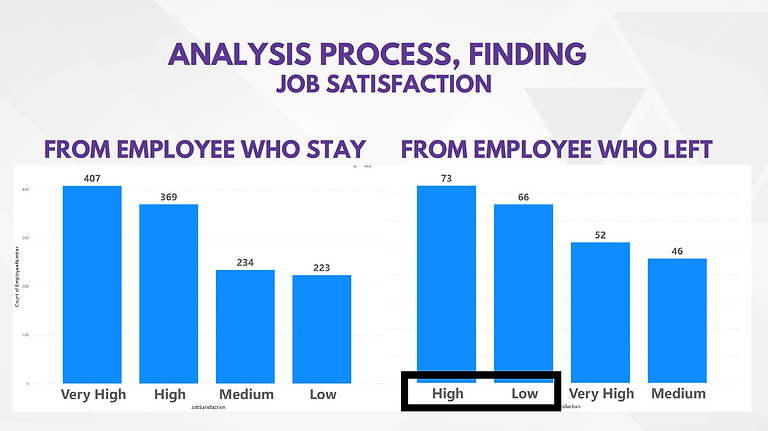
Job satisfaction shows a clear relationship with employee attrition.
Employees who remain at the company tend to report:
• higher satisfaction levels
• stronger engagement with their work
In contrast, employees who leave are more likely to report lower job satisfaction.
This suggests that improving job satisfaction may play an important role in reducing employee turnover.
Work Environment Impact
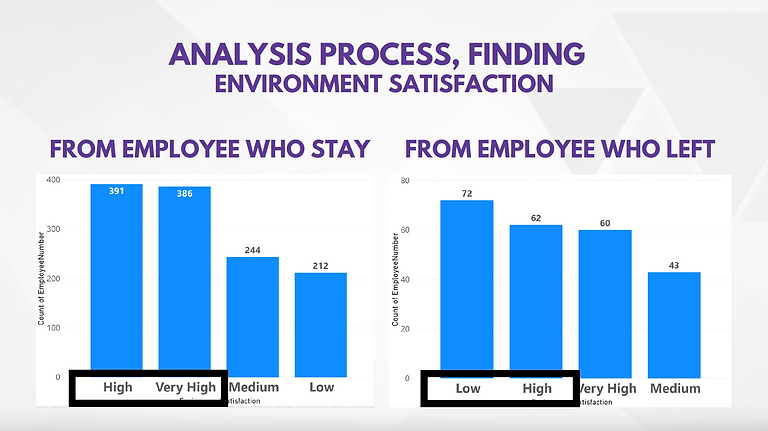
Workplace environment satisfaction also strongly influences employee retention.
Employees who stay generally report:
High or Very High environment satisfaction
Employees who leave tend to report:
Low or Medium satisfaction
This suggests that workplace conditions and organizational culture play a major role in employee retention decisions.
Compensation Analysis
Compensation appears to be another key factor associated with attrition.
Employees who remain at the company earn an average monthly income of approximately:
$6.83K
Employees who leave earn approximately:
$4.79K
Lower income levels may increase the likelihood that employees seek opportunities elsewhere.
Job Role Risk Analysis
Certain job roles appear to experience higher attrition rates.
Roles with higher turnover include:
-
Laboratory Technician
-
Sales Executive
-
Research Scientist
These roles represent areas where HR teams may need to focus additional retention strategies.
Tenure Analysis
Employee tenure also influences attrition patterns.
Employees who leave the organization tend to have shorter tenure, suggesting that retention efforts should focus on employees during the early years of employment.
Key Insights
The analysis identified several key factors associated with employee attrition:
Work environment satisfaction is strongly linked to retention.
Lower-income employees are more likely to leave.
Certain job roles experience higher turnover risk.
Employees with lower satisfaction levels are more likely to exit the company.
These insights highlight the importance of workplace experience, compensation, and employee engagement in retention strategies.
Recommendations
Based on the findings, several actions are recommended.
Improve Workplace Environment
Organizations should further investigate workplace conditions and employee feedback to improve overall job satisfaction.
Support Lower-Income Employees
Management should provide career development opportunities and salary progression paths for employees in lower compensation ranges.
Focus on High-Risk Roles
Departments experiencing higher turnover should implement targeted retention strategies such as mentorship programs or additional incentives.
These measures can help reduce employee turnover and improve overall workforce stability.
Identifying High-Risk Employees
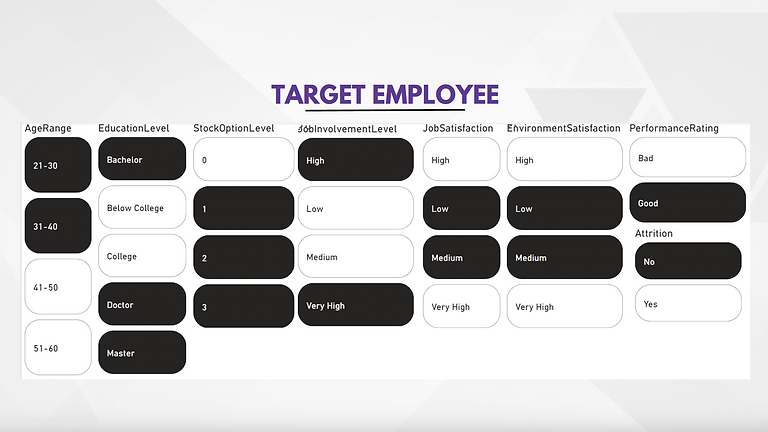
To make the analysis actionable, we developed a framework to identify employees who may be at higher risk of leaving the company.
Using patterns observed in the attrition analysis, we evaluated employees based on:
-
satisfaction levels
-
income level
-
job role
-
stock options
-
performance indicators
-
education level
Employees whose profiles closely matched those of past employees who left were flagged as potential attrition risks.
Target Employee Group
The analysis identified 29 employees who share similar characteristics with employees who previously left the organization.
These employees represent individuals who may be at higher risk of attrition and could benefit from proactive HR intervention.
By focusing on this group, HR teams can:
• address employee concerns early
• provide targeted career support
• improve engagement
• reduce turnover risk
This allows organizations to shift from reactive turnover management to proactive employee retention.
Final Insight
This project demonstrates how HR analytics can transform employee data into actionable insights that help organizations improve workplace satisfaction, reduce attrition risk, and proactively retain key employees.